
Although there is near-universal agreement on the necessity of strategic planning, very few companies truly do it well.
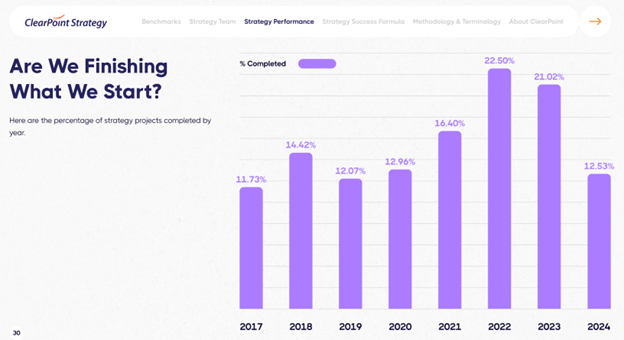
Even companies with strategic plans struggle to successfully execute them and accomplish the goals – less than 15% of strategic projects are successfully completed within the year, according to ClearPoint Strategy.
In past years, a missed goal here or there wasn’t necessarily disastrous for the company’s long-term prospects or competitive advantage.
But with the ever-increasing volatility, uncertainty, complexity, and ambiguity (VUCA), missing goals – even just one – can put the company in a difficult position. As an example of the current impact, McKinsey provides data that shows how missed goals can cost a company up to 10% of its annual revenue.
There are many reason why companies miss goals, some of which we go into here!
Ultimately, many goals fail to materialize as intended because they simply were not the right fit for the company at that time.
In the course of researching his book Focus: How to Plan Strategy and Improve Execution to Achieve Growth, Dr. Vikus Mittal of Rice University explains that:

The frequent result of this way of thinking is executives, along with the rest of the company, spend their time putting out fires or otherwise ‘reacting.’ Not only is this mode stressful, it puts the outcome of goals in jeopardy.
ERM has traditionally been engaged ‘after the fact’ during the strategy setting process, a fact we explore in-depth in this foundational article. This timing simply feeds the perception of ERM being a cost-center instead of a profit-driver.
To shift this perception, and more importantly, be an enabler of your company’s competitiveness and success, ERM must merge with strategy. In other words, ERM should be in the midst of strategy conversations, whether you have an off-site session or a series of on-site meetings.
This article provides a proactive tool that executives and ERM practitioners alike can use during the different phases of the strategic planning process to truly embed ERM within the strategy setting process.
Before asking the following questions and doing any planning, company leaders need to understand that ‘top risks’ should be based on the biggest risks to the company’s most important objectives.
Company leaders can use some or all of the following questions at critical junctures of the strategic planning process to identify the right goals, the metrics to track progress against those goals, and the projects the company will execute to achieve those goals.
Pre-planning
- How has the company profile (i.e., market, customers, products, financials) changed since last year?
- Which objectives from the past year did we underachieve on? Why?
- What were the root causes of the biggest risk events in the last year?
- What are the biggest areas of concern in the industry and general external environment?
- Which areas of our organization are most susceptible?
Planning phase
- What are some scenarios for the achievement of each objective? Which scenarios are most likely to occur?
- Which scenarios look the riskiest? Why?
- Do we have adequate capabilities to manage these scenarios if they materialize?
- What assumptions are we making when selecting each goal?
- What are some of indicators of success and failure for each goal?
- Which objectives have the most uncertainty and least uncertainty? Are these levels acceptable?
Post-planning
- Have we assigned clear ownership for each of the objectives and action plans?
- Do we have monitoring in place for objectives, risks, and action plans?
- What are the potential obstacles and opportunities to achieving the strategic objectives articulated through the planning process? Which can we control? Which are beyond our control?
- What plans do we have in place for these obstacles? Opportunities?
- Do we have a clear escalation mechanism to trigger a response to a scenario where the indicator goes beyond its designated threshold?
Click here for a handy downloadable of these questions you can have on hand during strategic planning sessions.
One thing to notice about these questions – how little the word ‘risk’ is used. While using it can’t be completely avoided, the perception of what constitutes a ‘risk’ will vary depending on the industry and perspectives of company leaders, which is why some thought leaders propose shedding the risk management label altogether.
In the end, the management’s goal shouldn’t be to completely eliminate risk to objectives, which would be impossible. Instead, the purpose of questions like these is to increase certainty that the goals the company chooses will be achieved and the objectives are successfully executed.
Like the Hedgehog concept, these questions represent another tool for shifting ERM from the rear-view mirror to the front windshield.
Simply introducing these questions into the strategic planning process has the potential to deliver what leaders need to make informed decisions about the company’s future course. Also, coupling these questions with advanced quantitative analysis tools can help ERM shift strategic planning from just a gut instinct to a methodical, systemic process Dr. Mittel describes above.
Because one thing is becoming clearer with each passing day – the old ‘risk list’ approach, as opposed to an objective-centric one, is simply not helpful for successfully navigating today’s business climate.
What other ways have you tried to merge ERM with strategic planning?
We invite you to join the conversation on LinkedIn to share your thoughts.
Featured image courtesy of Andrea Piacquadio via Pexels.com